Wikipedia doesn’t run ads. It doesn’t sell user data. It doesn’t take venture capital. Instead, it asks its readers for money-directly, plainly, and sometimes, frequently. Every year, millions of people see a simple banner at the top of a Wikipedia page: "Did you know Wikipedia is nonprofit? We rely on donations." But here’s the twist: those banners aren’t random. They’re the result of hundreds of A/B tests run by the Wikimedia Foundation to find out which words, colors, and layouts get people to give.
How A/B Testing Works on Wikipedia
Every time you visit Wikipedia, you might see a different fundraising message. One user sees a banner with a photo of a librarian holding a book. Another sees a plain text version with bold numbers: "15 million people donate every year." A third sees a banner with no image, just a single sentence in dark blue. These aren’t design choices made by committee. They’re the output of controlled experiments.
The Wikimedia Foundation runs A/B tests on its fundraising banners like a tech startup tests a landing page. They change one variable at a time: font size, color contrast, placement, emotional appeal, or even the exact wording. Then they measure what happens. Do more people click? Do they give more money? Do they leave the site and never come back?
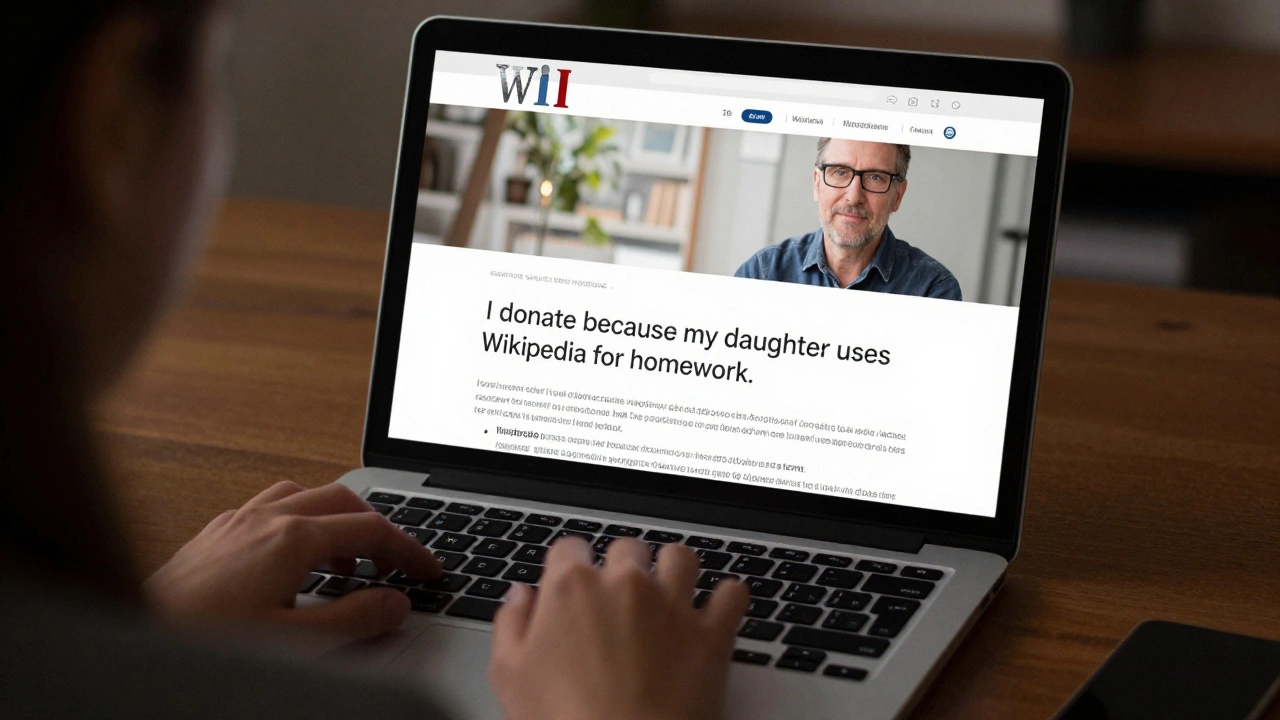
In 2023, a test showed that banners with a personal story-"I donate because my daughter uses Wikipedia for homework"-raised 12% more than those using generic statistics. Another test found that placing the banner at the bottom of the page, instead of the top, reduced bounce rates by 8% but also cut donations by 17%. The Foundation chose the top placement. Revenue won.
The Ethical Tightrope
Wikipedia’s mission is simple: "to empower and engage people around the world to collect and develop educational content under a free license." It’s a promise made to readers, editors, and volunteers. But fundraising banners turn readers into donors. And when you A/B test those banners, you’re not just optimizing for clicks-you’re manipulating emotions.
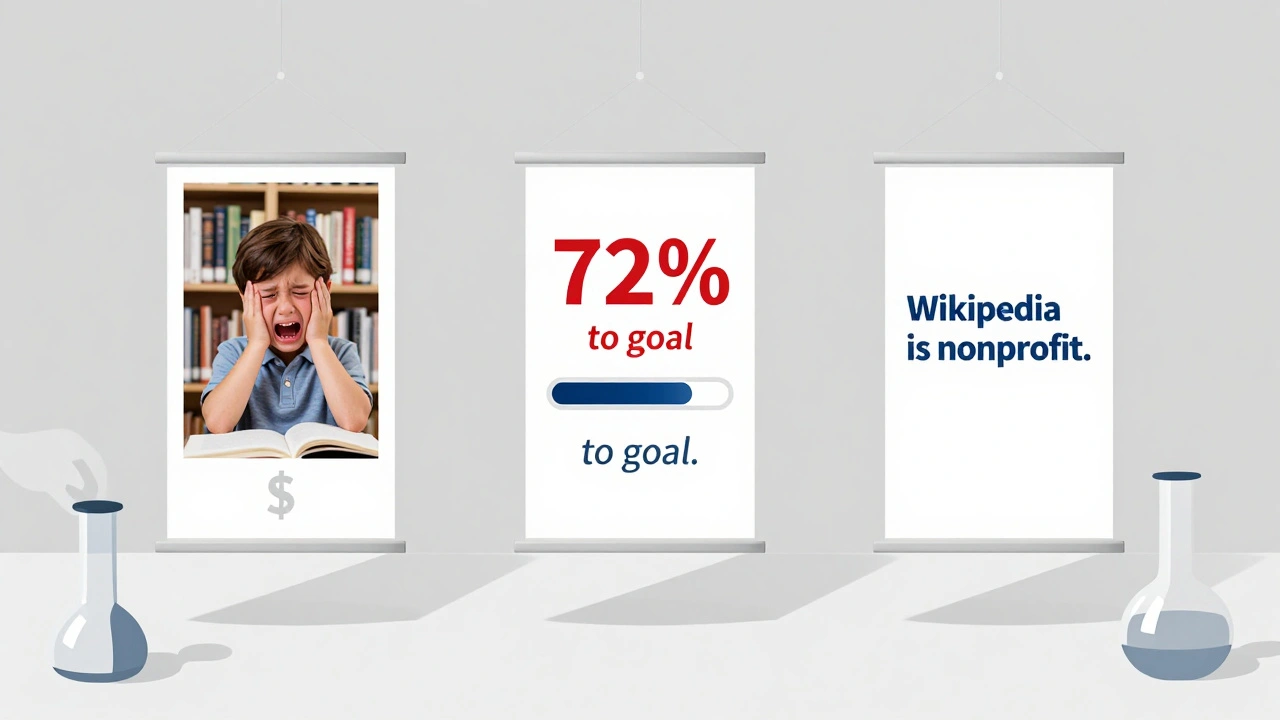
Is it ethical to use psychological triggers? To test how fear, guilt, or nostalgia affect giving? To find out that a banner with a crying child in a library raises more money than one showing a scientist in a lab? The Foundation doesn’t hide this. They publish their methods. But they don’t ask readers if they want to be part of the experiment.
Think about it: you’re reading an article about quantum physics. You’re not trying to donate. You just want information. Then a banner pops up, designed to make you feel like you’re letting down a child who depends on Wikipedia. Is that consent? Or is it coercion dressed up as community?
Some volunteers have walked away over this. One longtime editor, who asked to remain anonymous, said: "I helped build this. I don’t recognize it anymore. It’s becoming a charity with a encyclopedia inside."
What the Data Shows
The numbers don’t lie. In 2024, Wikipedia raised over $160 million from individual donors. That’s more than double what it made in 2015. Most of that growth came from optimized banners. Here’s what the data says about what works:
- Personal stories outperform statistics by 11-14% in donation rate.
- Red banners get more clicks than blue or gray ones, but blue leads to higher average donation amounts.
- Banners with a progress bar (e.g., "We’re 72% to our goal") increase urgency and raise 9% more than static ones.
- Banners that mention "free knowledge" have higher retention rates-people who see them are more likely to return to Wikipedia later.
- Mobile users donate 23% more when the banner is sticky (stays at the top as they scroll).
But here’s the hidden trade-off: the more effective the banner, the more it disrupts the user experience. In 2022, internal data showed that banner-heavy pages saw a 6% drop in pageviews per session. People weren’t leaving because they were mad-they were just distracted. The site became harder to use.
Who Decides What You See?
There’s no public board reviewing banner designs. No volunteer council. No transparency portal. The decisions are made by a small team inside the Wikimedia Foundation’s fundraising division. They’re not editors. They’re not historians. They’re data analysts and behavioral psychologists trained in conversion optimization.
They don’t work for Wikipedia’s community. They work for its budget.
Wikipedia’s funding model is unique. It doesn’t rely on advertisers, governments, or corporations. That’s its strength. But it also means every dollar must be earned from users. And when you’re under pressure to hit revenue targets, the line between persuasion and manipulation gets blurry.
Compare this to a public library. Would a library A/B test its donation requests? Would it try to make you feel guilty for not giving? Would it use a crying child’s photo to get more cash? Most wouldn’t. They’d just ask, plainly, and leave it at that.
The Unspoken Trade-Off
Wikipedia’s success is built on trust. People believe it’s neutral. They believe it’s free. They believe it’s not for sale. When a banner pops up, it’s supposed to be a quiet request-not a psychological nudge.
But the data doesn’t care about ideals. It cares about outcomes. And the outcome is clear: optimized banners work. They raise more money. They keep the servers running. They let Wikipedia stay ad-free.
So is it worth it? If you value a world where anyone can access knowledge without ads or paywalls, then maybe yes. But you’re paying for it with your attention, your peace of mind, and your sense of autonomy.
There’s no perfect answer. Only trade-offs. And the real question isn’t whether A/B testing works-it’s whether we’re okay with Wikipedia becoming a charity that looks like a library, but operates like a startup.
What Could Change
There are alternatives. One idea: limit banners to once per user per month. Another: let users choose their banner type-text-only, story-based, or none. A third: publish all test results publicly so editors and readers can review them.
Some volunteers have started a movement called "Free Knowledge First," pushing for stricter limits on banner frequency and transparency in testing. They’ve gathered over 12,000 signatures. The Foundation hasn’t responded.
For now, the banners keep coming. The tests keep running. And the money keeps flowing.
Does Wikipedia track who clicks on fundraising banners?
Wikipedia doesn’t track individual users by name or account when they see or click on fundraising banners. The system only records anonymous data-like how many people saw a banner, whether they clicked, and if they donated. No personal identifiers are stored. The goal is to measure effectiveness, not to build profiles.
Why doesn’t Wikipedia use ads instead of donation banners?
Wikipedia has consistently rejected advertising because it believes ads compromise neutrality. Advertisers influence content, even subtly. A search engine might favor companies that pay for placement. A news site might avoid reporting on industries that advertise with them. Wikipedia’s editors and users want to avoid any perception that content is shaped by money-not just ads, but any commercial influence.
How much of Wikipedia’s budget comes from banners?
In 2024, over 95% of Wikipedia’s $160 million budget came from individual donations collected through fundraising banners. The rest came from grants, foundations, and corporate sponsorships-but those are restricted to specific projects and cannot be used for core operations like server costs or staff salaries.
Can users opt out of seeing fundraising banners?
Users can’t opt out of seeing banners entirely, but they can dismiss them permanently by clicking the "X" in the corner. Once dismissed, the banner won’t reappear for that browser session. However, it will return the next time you visit from a different device, browser, or after a few weeks. There’s no account-based opt-out because Wikipedia doesn’t require users to log in.
Are A/B tests on banners reviewed by the community?
No. The Wikimedia Foundation runs A/B tests internally without community oversight. While some test results are published in annual reports, the full datasets, hypotheses, and design iterations are not made public. This has led to criticism from volunteers who believe decisions affecting the user experience should involve those who contribute to the site.