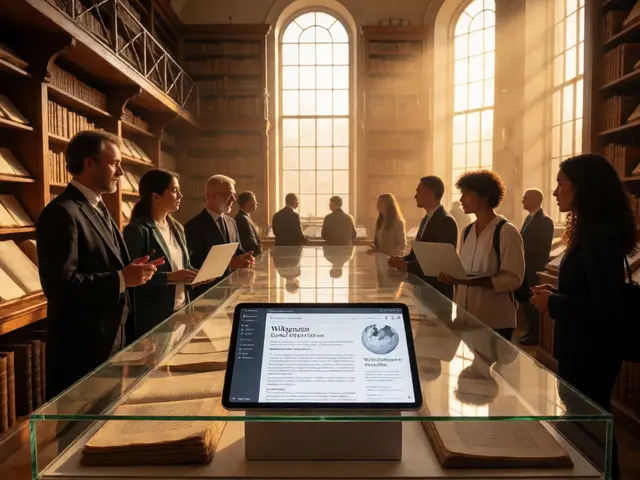
Wikipedia isn’t just a website you check before writing a paper. For students, professors, and researchers, it’s become a silent partner in how knowledge is shared, debated, and built. In education journalism - the practice of reporting on learning, teaching, and scholarship - Wikipedia plays a role no textbook or journal ever could. It doesn’t just report facts. It changes how those facts are made, tested, and trusted.
Wikipedia as a Living Textbook
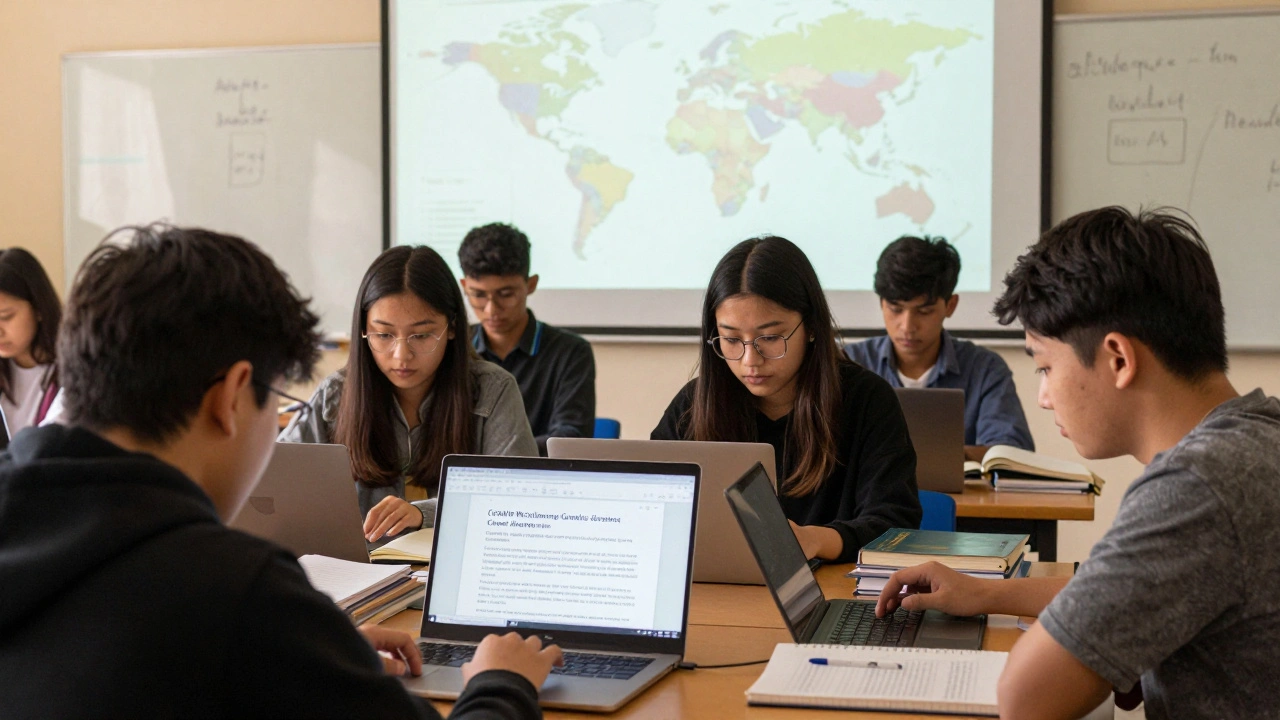
Every semester, thousands of university professors assign Wikipedia editing as part of their curriculum. At Stanford, students in a history class rewrite articles on Cold War diplomacy using primary sources. At the University of Edinburgh, biology students update entries on genetic disorders based on the latest peer-reviewed studies. These aren’t side projects. They’re graded assignments that count toward credit.
Why? Because editing Wikipedia forces students to do real research. They can’t just copy-paste from a website. They have to find credible sources, evaluate them, and write clearly for a global audience. A 2023 study from the University of California found that students who edited Wikipedia articles improved their source evaluation skills by 42% compared to those who wrote traditional essays. They also learned how to spot bias - not just in others’ writing, but in their own.
This isn’t about making Wikipedia better. It’s about making students better thinkers. When you know your work will be read by people in Nairobi, Rio, or Seoul, you don’t cut corners. You double-check. You cite. You revise. That’s the heart of education journalism: clear, accurate, accountable storytelling.
The Peer Review That Never Sleeps
Academic journals take months - sometimes years - to publish a single paper. Peer review is slow. Wikipedia is instant. An article on a newly discovered species of deep-sea worm can be updated within hours of the study being released. A professor in Tokyo spots an outdated statistic in a Wikipedia entry on climate models. They edit it. Another editor in Berlin reviews the change. Within a day, the correction is live. No subscription. No paywall. No delay.
This is why many researchers now treat Wikipedia like a preprint server. They don’t wait for journal approval to share findings. They publish on Wikipedia first. Then they cite it in formal papers. A 2024 survey of 1,200 academic librarians found that 68% had seen students or colleagues reference Wikipedia in scholarly work - not as a last resort, but as a starting point.
It’s not chaos. It’s structured collaboration. Wikipedia’s talk pages function like open peer review forums. Anyone can question a claim. Anyone can suggest a source. Editors follow guidelines like verifiability and no original research. These aren’t arbitrary rules. They’re the same standards that govern academic publishing - just faster, more transparent, and open to everyone.
Breaking Down the Ivory Tower
For decades, academic knowledge was locked behind paywalls. A single journal article could cost $40. Libraries paid thousands per year just to keep access. Meanwhile, Wikipedia offered free, instant access to summaries of nearly every major theory, discovery, and debate.
This changed who gets to participate in scholarship. A high school student in rural Kenya can read about quantum entanglement. A single mother in Detroit can learn how to interpret medical studies on maternal health. A retired engineer in Poland can fact-check claims about renewable energy. Wikipedia doesn’t care about credentials. It cares about evidence.
That’s why education journalists now track Wikipedia traffic as a barometer of public interest. When a major scientific breakthrough happens - like the first image of a black hole - Wikipedia’s page on the topic spikes to over 2 million views in 72 hours. That’s more than all academic journals combined. It means the public isn’t just consuming knowledge. They’re engaging with it. And that engagement shapes how educators teach.
The Blind Spots and the Fixes
Wikipedia isn’t perfect. It has gaps. Articles on Indigenous knowledge systems, non-Western history, and women scientists are often underdeveloped. A 2022 analysis of 500,000 biology articles found that only 18% mentioned female researchers by name. In philosophy, 73% of biographies were of men.
But here’s the thing: those gaps aren’t ignored. They’re being fixed. Groups like WikiProject Women in Red and WikiProject Global South organize edit-a-thons across continents. Universities host workshops to train students in editing underrepresented topics. In 2025, over 15,000 new articles on African scholars were created - mostly by African students themselves.
Education journalism isn’t just about reporting on these efforts. It’s about amplifying them. When a professor writes an article explaining how Wikipedia corrects historical erasure, they’re not just informing readers. They’re inviting them to join the work.
What This Means for the Future of Learning
Imagine a classroom where the textbook is updated daily. Where students don’t just memorize facts - they help write them. Where the line between learner and contributor vanishes. That’s not science fiction. It’s happening now.
Wikipedia’s role in education journalism is simple: it turns passive readers into active participants. It doesn’t replace academic journals. It complements them. It doesn’t replace professors. It empowers them. It doesn’t replace critical thinking. It demands it.
The future of education isn’t in closed-door seminars or expensive databases. It’s in the open, collaborative space where knowledge is built - together.
Can Wikipedia be trusted as a source in academic work?
Wikipedia itself is rarely cited as a primary source in formal academic papers. But it’s widely used as a starting point to find credible sources. Most Wikipedia articles include references to peer-reviewed journals, books, and official reports. Students are taught to trace claims back to those original sources. Many universities now train students to use Wikipedia’s citation trail as a research tool - not as an endpoint.
Why do professors assign Wikipedia editing?
Because it teaches real-world skills: research, writing for public audiences, evaluating sources, and collaborative editing. Unlike traditional essays that only one professor reads, Wikipedia articles are seen by millions. That accountability raises the quality of student work. Studies show students who edit Wikipedia develop stronger critical thinking and digital literacy than those who write standard papers.
Is Wikipedia biased toward Western perspectives?
Yes, historically it has been. But that’s changing. Since 2020, volunteer groups and universities have launched targeted projects to expand content on non-Western history, Indigenous knowledge, and underrepresented scholars. In 2024 alone, over 200,000 new articles were created on African, Asian, and Latin American topics. These efforts are led by local communities - not outsiders.
Do scientists really use Wikipedia to share new research?
Yes. Many researchers, especially in fast-moving fields like medicine and climate science, use Wikipedia to summarize new findings before formal publication. It’s not a substitute for peer-reviewed journals - but it’s a way to make cutting-edge science accessible to the public and other experts. Some journals even encourage authors to update relevant Wikipedia entries alongside their papers.
How does Wikipedia handle misinformation?
It doesn’t ignore it - it confronts it. Wikipedia has automated tools that flag sudden edits, especially on controversial topics. Human editors review changes, check sources, and revert false claims. Articles on medical topics, politics, and science are protected from anonymous edits. When misinformation spreads - like during the pandemic - Wikipedia’s community responded faster than most media outlets, correcting false claims within hours.