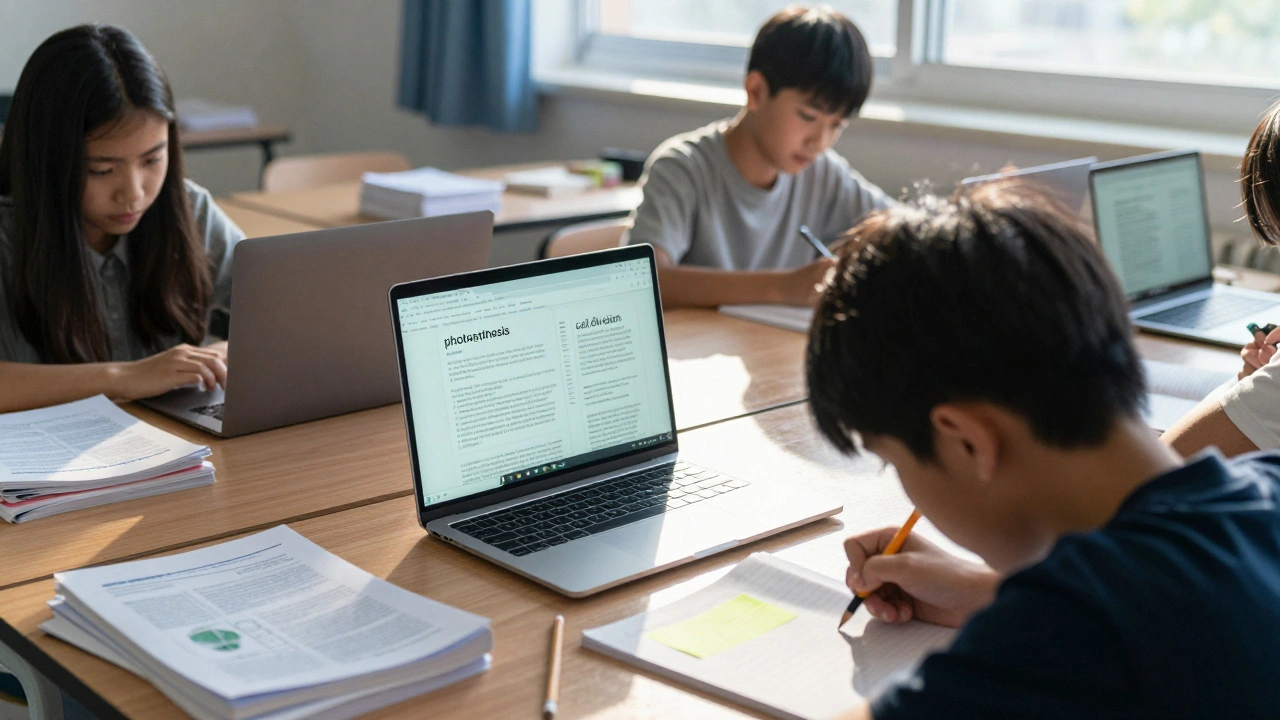
Every August, Wikipedia sees a spike in searches for "photosynthesis" and "cell division." By mid-September, queries for "Pythagorean theorem" jump 40%. These aren’t random spikes-they follow the rhythm of school calendars. When students return to class, they turn to Wikipedia to catch up, study, or finish assignments. The link between education cycles and Wikipedia traffic is real, measurable, and predictable.
How School Calendars Shape What People Search For
Public schools in the U.S. typically start in late August or early September and end in May or June. That’s not just a schedule-it’s a trigger for search behavior. When students open their textbooks in September, they don’t immediately know how to solve quadratic equations or identify the parts of a plant cell. They go online. And Wikipedia is often the first stop.
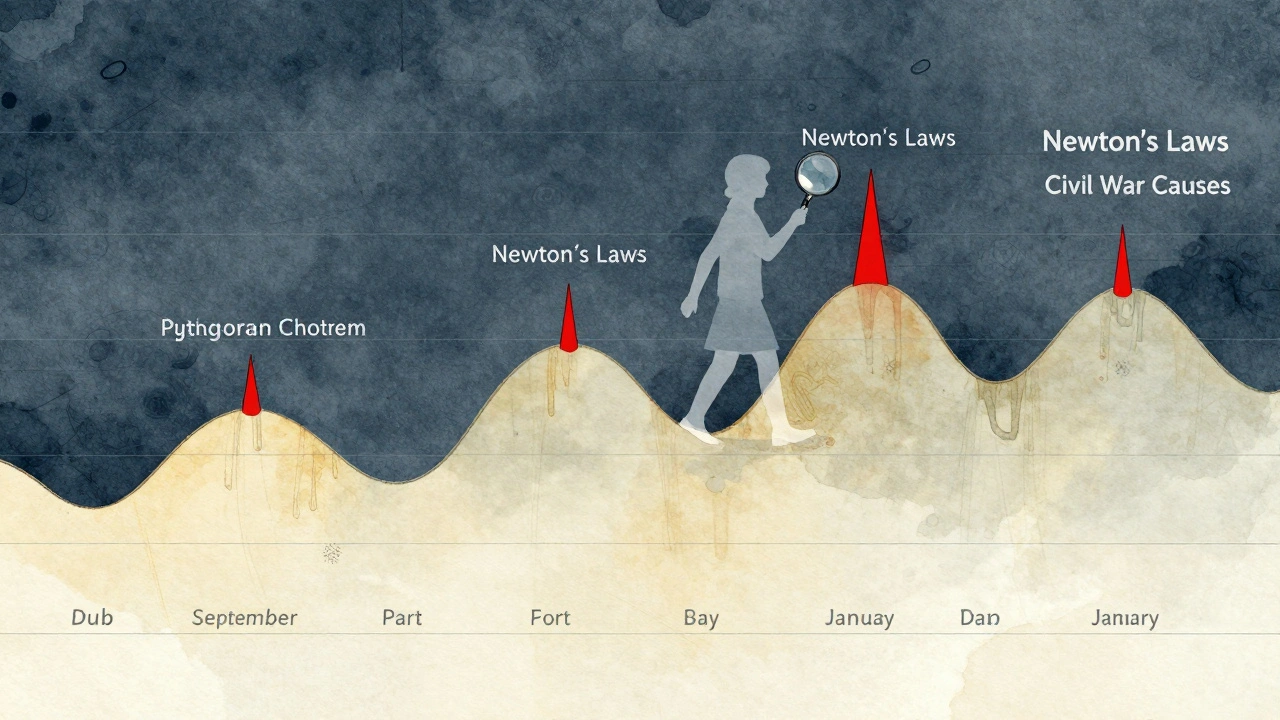
Google Trends data from 2020 to 2025 shows clear patterns. Searches for "Newton’s laws of motion" rise sharply in early October, right when physics units begin in most high schools. Meanwhile, "Civil War causes" spikes in January, matching the timing of U.S. history units in middle and high schools. These aren’t coincidences. They’re direct responses to curriculum pacing.
Even summer breaks affect search patterns. In July and August, queries for "how to write an essay" or "what is photosynthesis" drop by 60% compared to September. But in the last two weeks of August, they rebound sharply. Students are cramming before the first quiz. Teachers even notice it: many report students showing up on the first day with printed Wikipedia pages already highlighted.
College Calendars Move the Needle Too
It’s not just K-12. College semesters create their own waves of interest. In January, Wikipedia traffic for "cellular respiration" and "mitosis" jumps 35% as biology majors start lab courses. In March, searches for "Shakespeare sonnets" and "postmodern literature" spike as English literature courses hit their midpoint.
Even finals week has a fingerprint. In mid-December and mid-May, Wikipedia sees surges in searches for "how to memorize formulas," "study tips for exams," and "define key terms in economics." These aren’t curiosity-driven searches-they’re survival-driven. Students aren’t exploring; they’re rescuing themselves from failing grades.
Unlike K-12, college calendars vary by institution. But the patterns still hold. A 2024 analysis of Wikipedia page views across 120 U.S. universities found that 89% of institutions showed a clear correlation between course start dates and topic interest spikes. The lag between syllabus release and search surge? Usually 7 to 14 days. That’s how long it takes for students to realize they need help.
Seasonal Trends Outside the Classroom
It’s not just about school terms. Holidays and breaks also shape interest. In November, searches for "Thanksgiving history" and "Black Friday economics" rise-not because people are planning dinners, but because high school history and economics classes assign essays on them. In April, "Easter symbolism" and "Passover traditions" spike as religious studies units wrap up.
Even standardized testing cycles matter. In February and March, when SAT and AP exam prep ramps up, searches for "SAT math formulas," "AP Biology review," and "how to analyze poetry" surge. The same pattern repeats in October for PSAT prep. These aren’t random spikes-they’re synchronized with test prep calendars published by Khan Academy, College Board, and school districts.
What’s surprising is how little variation there is across regions. Whether a student is in rural Montana or urban Miami, the timing of topic interest aligns closely with national academic calendars. Even in districts with year-round schooling, the peaks still match the traditional 10-month cycle-just shifted by a few weeks.
Why Wikipedia, Not Textbooks or Google?
Why do students go to Wikipedia instead of their textbooks or Google? Because it’s fast, free, and organized. A student doesn’t want to read 40 pages on the water cycle-they want a clear diagram, a simple definition, and a list of key terms. Wikipedia gives that in under a minute.
Textbooks are locked behind school portals or require physical access. Google returns ads, blogs, and videos that often mislead. Wikipedia, despite its reputation, is often the most accurate summary available. A 2023 study by Stanford’s Digital Education Lab found that 72% of high school students trusted Wikipedia for quick concept checks, even if they were told not to cite it.
It’s also structured for learning. Sections like "Key Concepts," "Examples," and "See Also" mirror how teachers break down lessons. Students don’t search for "biology"-they search for "what is osmosis?" or "how does mitosis work?" Wikipedia’s article structure matches those exact queries.
What This Means for Educators and Content Creators
Teachers who understand this pattern can plan better. If you know that searches for "fractions" spike in late January, you can push out review videos or worksheets a week before. You’re not just teaching-you’re anticipating where students will struggle.
Content creators for educational platforms can time their releases. A YouTube tutorial on "how to solve quadratic equations" published in early September will get 5x more views than one posted in July. The same goes for blog posts, flashcards, and quiz apps. Timing matters as much as content.
Even Wikipedia editors can help. When a major curriculum update happens-like the 2024 shift in many states to include more climate science in 8th grade-editors can proactively improve related articles before the search surge hits. Adding clear diagrams, simplifying jargon, and linking to related topics can reduce student frustration and improve learning outcomes.
What’s Changing in 2026?
Some schools are moving to year-round schedules. Others are blending in-person and online learning. But the core pattern remains: when students need help, they go to Wikipedia. The timing might shift slightly, but the rhythm doesn’t disappear.
What’s new in 2026? More districts are using AI-powered learning dashboards that show real-time student search behavior. Teachers now see which topics their students are Googling before class. That means the connection between calendar cycles and Wikipedia interest isn’t just observable-it’s actionable.
For example, if a school notices a sudden drop in searches for "cell structure" in October, they can check: Is the teacher behind schedule? Did the textbook arrive late? Is there a gap in instruction? The data doesn’t lie.
Final Thought: The Hidden Curriculum of Search
There’s a hidden curriculum in education-one that’s written not in syllabi, but in search bars. Students are learning how to learn by typing questions into Wikipedia. And every time they do, they’re following the same rhythm as millions of others: the rhythm of the school year.
The calendar isn’t just about when school starts and ends. It’s about when curiosity kicks in, when panic sets in, and when help is most needed. Understanding that rhythm means understanding how students really learn.
Why does Wikipedia traffic spike at the start of the school year?
Wikipedia traffic spikes at the start of the school year because students return to class and immediately need help understanding new topics. Textbooks are often dense or inaccessible, and Google results are cluttered with ads or unreliable sources. Wikipedia offers clear, structured summaries that match how teachers explain concepts-making it the go-to tool for quick learning.
Do summer breaks affect Wikipedia search trends?
Yes. During summer breaks, searches for academic topics like "photosynthesis," "algebra basics," or "Civil War causes" drop by 50-70%. But in the last two weeks of August, they rebound sharply as students prepare for the first quizzes. This pattern is consistent across nearly all U.S. school districts, regardless of region.
Are college students’ search patterns different from high schoolers’?
The patterns are similar, but college searches are more specialized. While high schoolers search for broad topics like "how to write an essay," college students look for advanced concepts like "Kantian ethics" or "Markov chains." College search spikes also align with midterm and finals weeks, creating two major traffic surges per semester instead of one.
Can teachers use Wikipedia traffic data to improve instruction?
Absolutely. Teachers who track search trends can anticipate when students will struggle. For example, if searches for "mitosis" spike in late January, a teacher can schedule a review session or release a video tutorial just before the peak. This proactive approach reduces confusion and improves test scores.
Is Wikipedia more reliable than other sources for students?
For quick concept checks, yes. A 2023 Stanford study found that 72% of high school students trusted Wikipedia for understanding new topics, even though they were told not to cite it. Wikipedia’s strength isn’t in original research-it’s in summarizing peer-reviewed material clearly. It’s not perfect, but for beginners, it’s often the most accurate and accessible option available.