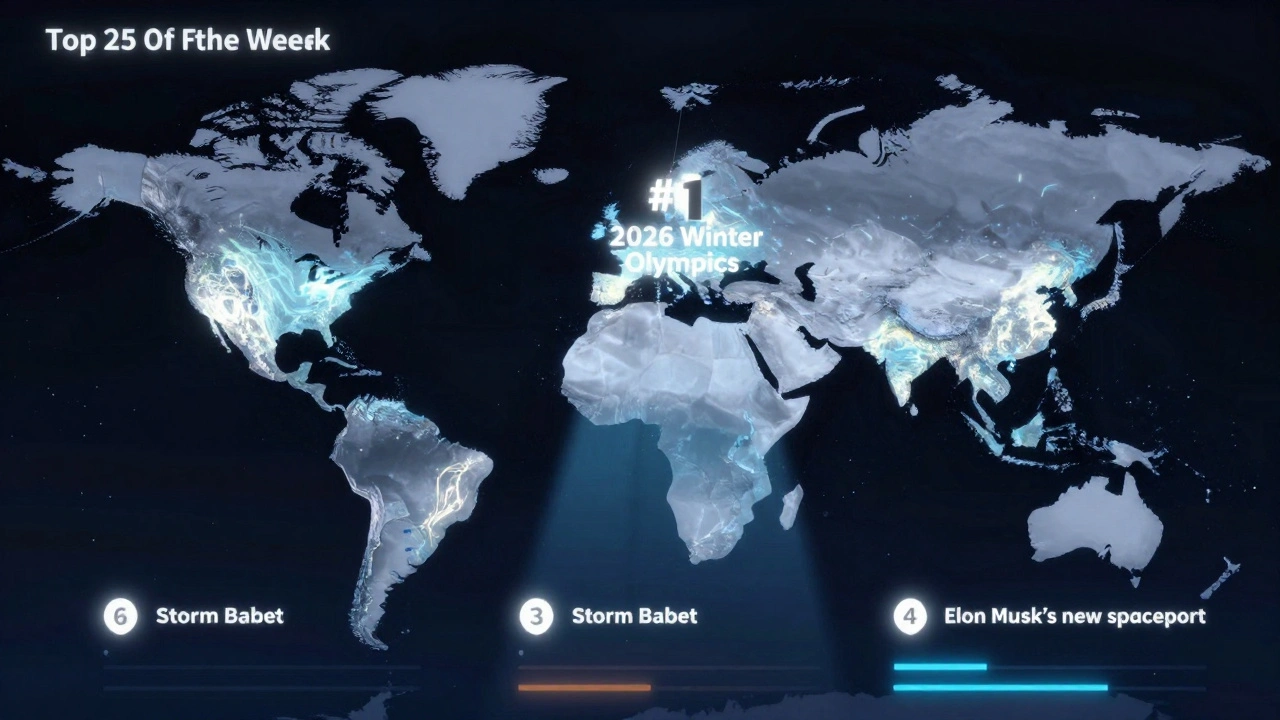
Every week, millions of people turn to Wikipedia for answers-whether they’re checking a fact, researching a topic, or just falling down a rabbit hole. But not all pages get the same attention. Some articles explode in traffic overnight, while others quietly sit in the background. The Top 25 Report on Wikipedia tracks these shifts, revealing what the world is curious about right now.
What the Top 25 Report Actually Shows
The Top 25 Report isn’t a ranking of the most edited or most important articles. It’s a snapshot of real human behavior: which pages got the most views in the last seven days. This data comes straight from Wikimedia Foundation’s public logs, updated every Monday. It doesn’t count bots or crawlers-just real people clicking through.
For example, in the week of February 17, 2026, the top article was 2026 Winter Olympics. Why? Because the opening ceremony was live-streamed, and viewers wanted quick facts about the host city, medal counts, and athlete bios. The article got over 12 million views that week. Meanwhile, Albert Einstein, which usually sits in the top 10, dropped to #34. That’s not because people stopped caring about him-it’s because the news cycle moved on.
This report is like a pulse check on global curiosity. It changes fast. One day, it’s a celebrity death. The next, it’s a major weather event or a viral scientific discovery.
How the Top 25 Is Compiled
Wikimedia doesn’t guess or estimate. They count every single page view from every country, device, and language version of Wikipedia. The report includes:
- English-language pages (the largest segment)
- Pages from other language Wikipedias (like Spanish, Japanese, and Arabic)
- Mobile and desktop traffic
- Views from Wikipedia’s app and third-party tools
Each page is counted once per user per day. So if someone refreshes the page 10 times, it still counts as one view. This prevents artificial inflation from bots or obsessive checkers.
The data is filtered to exclude automated traffic-like search engine crawlers or library systems-that don’t reflect real human interest. That’s why you’ll never see a page like Wikipedia:Main Page in the top 25, even though it gets millions of views daily. It’s not a topic-it’s a portal.
What’s Driving This Week’s Top 25
Looking at the latest Top 25 (week of February 17-23, 2026), here’s what stood out:
- 2026 Winter Olympics - 12.4 million views
- 2026 United States presidential election - 9.7 million views
- Storm Babet - 8.9 million views
- Elon Musk’s new spaceport - 7.6 million views
- 2026 Nobel Prize in Physics - 6.3 million views
Storm Babet, a rare February storm that hit parts of Western Europe, made the list because people wanted to know its path, impact, and why it was unusual. The article was updated in real time as meteorological agencies released new data. That’s the power of Wikipedia: it becomes the living record of unfolding events.
Elon Musk’s new spaceport in Texas-officially called Starbase Expansion Site 7-wasn’t widely covered by mainstream news. But Wikipedia’s article, maintained by a team of volunteer editors, became the go-to source for maps, timelines, and regulatory details. That’s how niche topics can explode: when there’s no better source.

Why Some Pages Stay on the List
Not all top articles are news-driven. Some stick around because they’re perennially useful.
For example, COVID-19 pandemic still appears in the top 50 every few months. Why? Because people are still looking for updated stats, variant info, and long-term effects. Even though the emergency phase is over, the need for accurate, centralized information hasn’t disappeared.
Another constant? List of countries by population. It’s not flashy, but it’s referenced constantly by students, journalists, and researchers. It gets about 1.5 million views a week-steady as a heartbeat.
These pages survive because they’re well-maintained. Volunteers update them with new data from the World Bank, UN, and national statistics offices. They don’t wait for headlines-they monitor sources daily.
What the Top 25 Reveals About Global Interests
The Top 25 Report is more than a curiosity-it’s a cultural barometer.
In January 2026, when India’s Chandrayaan-3 moon mission made headlines, the article Chandrayaan-3 hit #2 globally. But in Brazil, the top article that week was 2026 Brazilian presidential election. Language and location matter. The English Wikipedia doesn’t tell the whole story.
When a major event happens, you’ll often see spikes in multiple language versions. For instance, during the 2026 floods in Pakistan, the Urdu Wikipedia article got over 5 million views in 48 hours-far more than the English version. This shows that Wikipedia’s true strength isn’t just in quantity, but in diversity.
There’s also a pattern: major political events spike traffic in the country involved, while scientific breakthroughs trend globally. A new cancer treatment? Top 10 worldwide. A local election? Top 10 in that region, nowhere else.
How Wikipedia Editors Respond to Traffic Surges
When an article suddenly gets 10 times its normal traffic, editors scramble. They don’t just add more text-they verify sources, fix broken links, and add citations from reliable outlets.
Take the 2026 Winter Olympics article. In the week leading up to the event, over 200 editors from 30 countries collaborated. They added:
- Updated medal tables
- Live results from official feeds
- Maps of venues
- Biographies of medalists
- Historical context from past Winter Games
This isn’t done by bots. It’s done by people-volunteers who care about accuracy. Many of them work full-time jobs and edit Wikipedia in their free time. They’re the reason Wikipedia stays trustworthy when other sites collapse under misinformation.
What’s Missing From the Top 25
There are gaps. Some topics get zero attention, even when they’re important.
For example, in the same week, the Global Carbon Budget 2026 report was released by the UN. It contained critical data on emissions trends. But the Wikipedia article got only 87,000 views. Why? Because it wasn’t tied to a headline. No celebrity, no disaster, no election. Just science.
This reveals a blind spot: Wikipedia reflects what’s trending, not what’s urgent. Climate science, public health infrastructure, and economic inequality rarely make the top 25-unless they’re tied to a crisis.
That’s why some educators and researchers encourage students to look beyond the Top 25. The most valuable knowledge isn’t always the most popular.
Can You Predict What Will Trend?
Not easily. But there are clues.
Events with scheduled dates-like elections, sports tournaments, or space launches-often spike in traffic a few days before. The Wikipedia article usually gets a surge of edits in the 72 hours leading up to the event.
Breaking news is harder. If a natural disaster strikes, the article can go from 5,000 to 500,000 views in a single day. Editors rely on trusted news sources like the BBC, Reuters, and AP to verify details before updating.
One pattern that holds: articles with clear, structured templates (like “Infobox” and “Timeline”) get updated faster and rank higher in search engines. That’s why Wikipedia pages with standardized formatting often dominate traffic.
Why This Matters
The Top 25 Report isn’t just trivia. It shows how the world learns in real time. When people turn to Wikipedia instead of Google News or TikTok, they’re choosing depth over noise. They’re choosing verified facts over speculation.
For students, it’s a study tool. For journalists, it’s a fact-checking baseline. For researchers, it’s a window into public interest. And for anyone who’s ever Googled something at 2 a.m.? It’s the quiet, reliable answer they didn’t know they needed.
Wikipedia doesn’t chase trends. It follows them-and turns them into knowledge.
How often is the Top 25 Report updated?
The Top 25 Report is updated every Monday, reflecting page views from the previous Monday to Sunday. The data is released by the Wikimedia Foundation around 10 a.m. UTC and is available on their public statistics page.
Does the Top 25 include non-English Wikipedia pages?
Yes, the report aggregates traffic across all language versions of Wikipedia. However, the main public list you see is usually the English-language top 25. Separate rankings exist for other languages, like Spanish, Japanese, and Arabic, and they often show very different topics based on regional interest.
Why do some articles get millions of views while others get almost none?
Articles tied to current events-like elections, disasters, or major scientific announcements-see huge spikes. But even then, visibility depends on how well the article is maintained. A well-structured, cited, and regularly updated page is more likely to appear in search results and get clicked. Poorly maintained pages, even on important topics, often get ignored.
Can I see the full list of the Top 25 for any week?
Yes. The Wikimedia Foundation publishes the full rankings for all language versions on their analytics page. You can filter by date, language, and region. Historical data goes back to 2015, so you can track trends over time.
Do celebrities always dominate the Top 25 when they die?
Not always. While celebrity deaths often cause spikes, the size of the spike depends on global recognition and cultural impact. For example, the death of a globally known figure like a pop icon or political leader typically sends their article to #1. But lesser-known celebrities may only get a few hundred thousand views. Wikipedia’s traffic reflects actual global interest, not just media hype.