
To get a handle on this, you have to look past the text and into the patterns. Understanding Wikipedia research in this context isn't just about reading arguments; it's about mapping who talks to whom, how power shifts during a dispute, and why some proposals get ignored while others become law. You're essentially studying a massive experiment in decentralized governance.
Quick Takeaways for Researchers
- Focus on the 'hidden' social networks: Who are the power users influencing the outcome?
- Track the lifecycle of a dispute from the first edit war to the final consensus.
- Use quantitative tools to complement qualitative reading to avoid confirmation bias.
- Analyze the role of 'policy citing' as a tool for legitimacy and power.
The Architecture of Deliberation
Before diving into the data, you need to understand what you're actually looking at. Wikipedia is a multilingual online encyclopedia written collaboratively by volunteers. But the actual deliberation happens on Talk Pages, which are the behind-the-scenes forums attached to every article. These pages aren't just chat rooms; they are the legal records of how information was vetted.
Deliberation here usually follows a specific path: an editor makes a change, another editor disagrees and reverts it, and they move to the talk page to argue their case. This is where the 'dynamics' come in. Is the conversation a polite debate, or is it a power struggle? In many cases, the person who has been on the site longest or has the most 'edits' carries an unspoken authority, regardless of the strength of their argument. This is a classic example of social capital in a digital environment.
Mapping the Social Network of Arguments
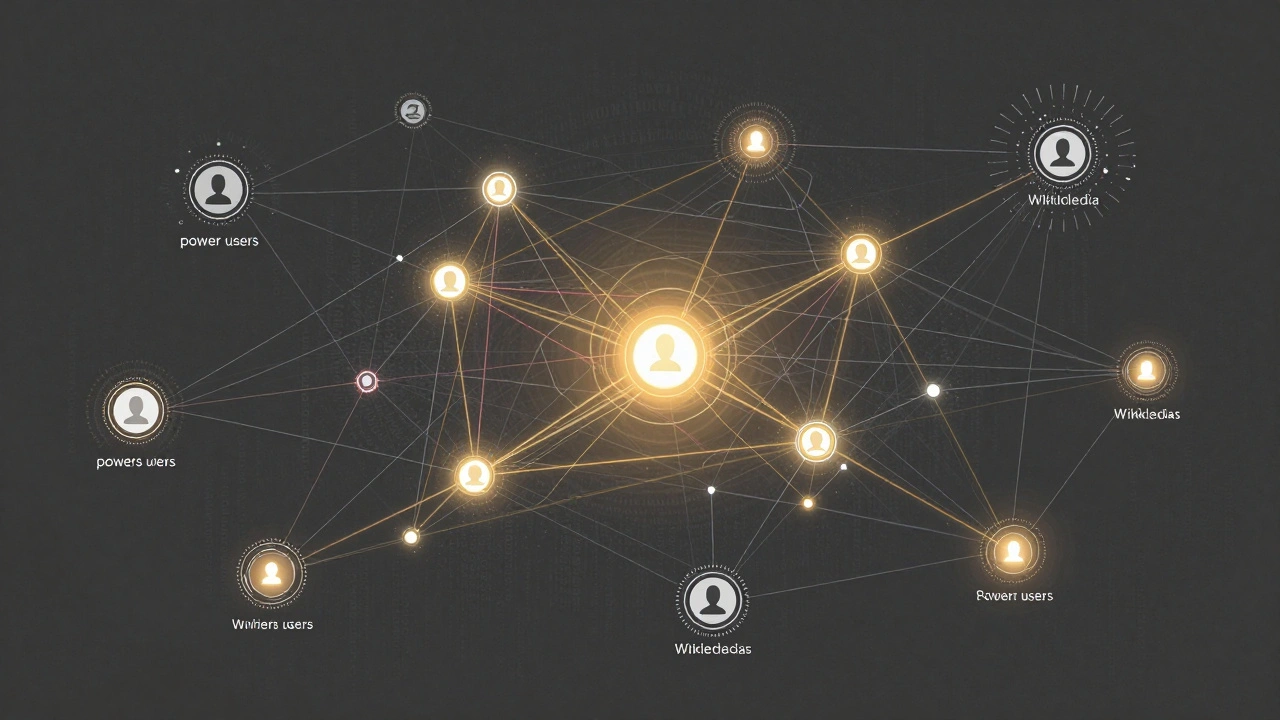
If you only read the text, you miss the structure. To truly see the dynamics, you have to treat the talk page as a network. Think of each user as a node and each reply as a link. When you map this, you often find that a small group of 'core' users-often called Administrators or experienced bureaucrats-act as the gatekeepers. They don't necessarily write the content, but they decide which arguments are valid.
For example, in a heated debate over a political figure's biography, you might see fifty people arguing, but only three people whose opinions actually move the needle. By using network analysis, you can identify these 'influencers.' If you're researching this, look for 'centrality' metrics. Who is the bridge between two opposing factions? Who is the isolated voice that gets ignored? These patterns tell you more about the community's health than the actual words spoken.
The Role of Consensus and Policy
On Wikipedia, 'truth' isn't just about facts; it's about Consensus. Consensus isn't necessarily a unanimous vote; it's the absence of a strong, evidence-based objection. This creates a strange dynamic where the person who knows the rulebook best wins. This is where the Wikipedia Policy comes into play.
When a user cites a specific policy-like 'Neutral Point of View' (NPOV) or 'Verifiability' (V)-they aren't just stating a rule; they are claiming authority. It's similar to a lawyer citing a statute in court. The deliberation shifts from "Is this true?" to "Does this meet the community's standards for truth?" This distinction is crucial. Research shows that users who can effectively 'weaponize' policy citations are far more likely to have their edits accepted, even if their sources are only marginally better than their opponent's.
Quantitative vs. Qualitative Approaches
You can't just pick one method if you want the full picture. If you only do a qualitative analysis (reading a few pages deeply), you might find a 'toxic' thread and assume the whole site is a battlefield. If you only do quantitative analysis (counting words or users), you'll see that the site is growing, but you won't understand why people are fighting.
| Metric | Qualitative Analysis | Quantitative Analysis |
|---|---|---|
| Focus | Nuance, tone, and intent | Scale, frequency, and patterns |
| Tools | Manual coding, discourse analysis | Python, R, SQL, API dumps |
| Strength | Understanding 'why' it happened | Proving 'how often' it happens |
| Risk | Researcher bias/small sample size | Missing the social context/nuance |
A pro tip: start with the quantitative to find the 'outliers'-the articles with the most edits or the longest talk pages-and then dive into those specifically with qualitative reading. This 'mixed-methods' approach allows you to find the anomalies and then explain them.
Common Pitfalls in Wikipedia Research
One of the biggest mistakes researchers make is treating Wikipedia like a traditional forum. It isn't. It's a knowledge graph with a social layer. For instance, many researchers ignore the 'User Talk' pages, focusing only on the 'Article Talk' pages. But a lot of the real negotiation-the 'I'll stop editing this section if you stop editing that one'-happens in private user spaces.
Another trap is ignoring the Wiki-API. Trying to scrape pages manually with a browser is a recipe for disaster. To get a real dataset, you need to use the MediaWiki API or the database dumps provided by the Wikimedia Foundation. This allows you to track 'revisions'-the exact moment a sentence changed-and link that change back to a specific discussion on the talk page. Without this temporal link, you're just guessing about cause and effect.
The Evolution of Digital Governance
Why does this even matter? Because Wikipedia is a proxy for how we might govern the rest of the internet. If we can figure out how a group of 100,000 strangers can agree on the biography of a deceased king without a central authority, we can apply those lessons to other areas of Digital Governance.
We see a shift over time from 'wild west' editing to a more structured, almost corporate form of moderation. Newer editors often find it harder to break into the inner circle because the 'rules' have become so complex. This creates a tension between openness (anyone can edit) and quality control (only experts should edit). Studying these dynamics helps us understand the trade-off between democratic participation and expert-driven accuracy.
Putting Your Research into Practice
If you're starting a project today, don't just pick a random topic. Pick a 'contested' topic. Look for articles with a 'Talk' tab that is three times longer than the article itself. These are the 'hot zones.' Track a single dispute over a period of six months. Who started it? Who mediated? How was the final wording reached? You'll likely find that the final text is a compromise that satisfies no one but is acceptable to everyone-the very definition of a political consensus.
How do I access historical talk page data?
The best way is through the Wikimedia dumps, which provide the entire database in a compressed format. For smaller-scale research, the MediaWiki API allows you to fetch specific page histories and revisions programmatically using Python libraries like Pywikibot.
What is the difference between an 'edit war' and a 'deliberation'?
An edit war is a repetitive cycle of reverting changes without communication. Deliberation begins the moment those users stop hitting 'undo' and start writing on the talk page to explain their reasoning. One is a conflict of actions; the other is a conflict of arguments.
Do 'power users' always win the arguments?
Not always, but they have a significant advantage. Their ability to cite obscure policies and their reputation among other admins often give their arguments more weight. However, a well-sourced argument from a new user can still win if it's backed by a high-quality primary source.
Can I use AI to analyze these dynamics?
Yes, Large Language Models are excellent for sentiment analysis and summarizing long debates. However, AI often struggles with the irony, sarcasm, and deep policy nuances that Wikipedia editors use. Always verify AI summaries with manual reading.
What is the 'Neutral Point of View' (NPOV) policy?
NPOV is a core Wikipedia principle requiring that articles be written in a neutral tone and represent all significant views fairly and without bias. In talk page dynamics, NPOV is frequently used as the primary benchmark to decide whether a piece of text is acceptable.